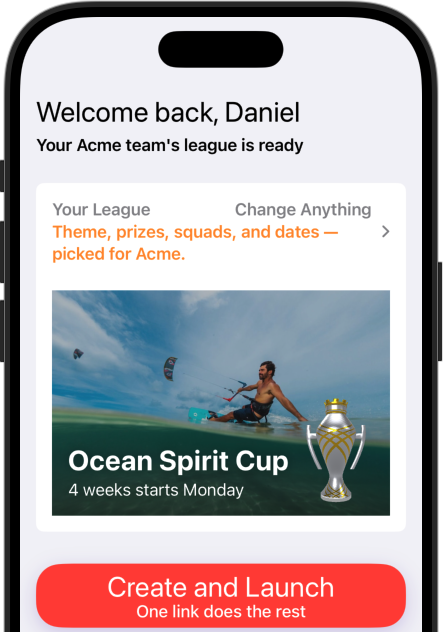
The AI reads your company profile and designs your entire league — theme, virtual arena, prizes, squads, and dates. You approve or change anything. Hit launch. 83% of teammates join from a personal link or QR on their first try.
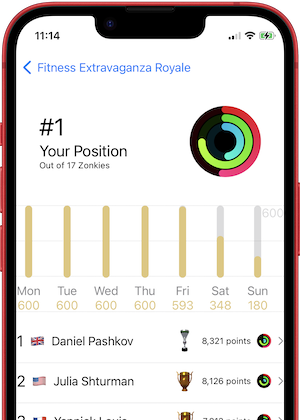
Scoring runs against each person's own Apple Activity targets — not absolute steps or calories. Close your rings, score the daily max. The triathlon CFO and the desk-bound engineer both compete to close their rings. Both can win. Mixed-fitness teams move 2.8x more.
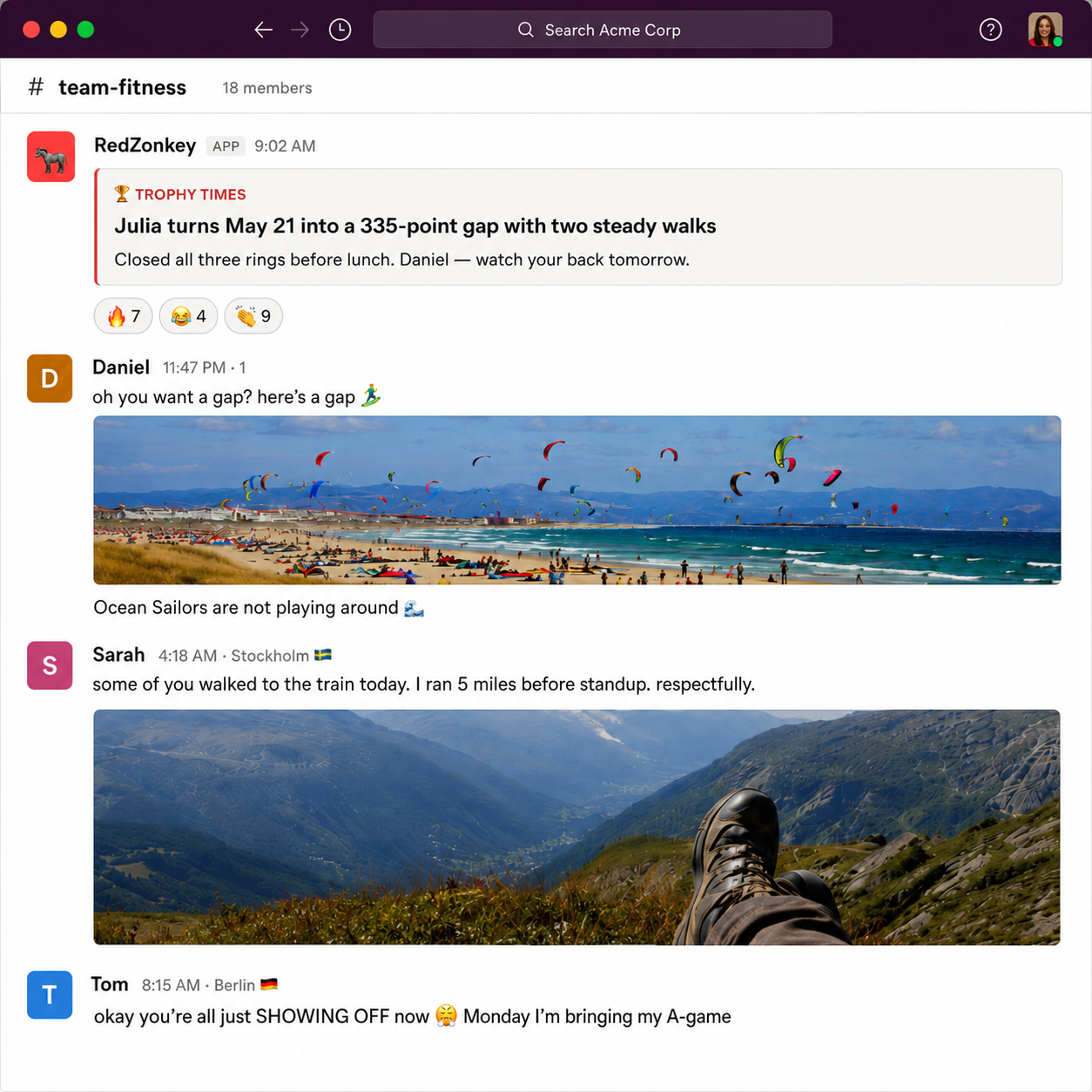
Personal comebacks, quiet streaks, rivalries tightening on the leaderboard, an underdog squad climbing — your team's moments become daily stories in your Slack, Reddit, or in-app. Everyone gets a story. Every squad gets a race. Top teams stay active 9+ months.
| Surveys & kudos | Wellness apps | Fitness platforms | Squads | |
|---|---|---|---|---|
| Daily engagement, not weekly | - | |||
| Works for non-athletes | ||||
| Lives in Slack & existing tools | - | |||
| AI-designed, zero setup work | ||||
| Themed seasons that feel like a game | ||||
| Creates connection between remote teammates | ||||
| Zero admin after launch | - | - |
| Other tools | Squads | |
|---|---|---|
| Daily engagement, not weekly | ||
| Works for non-athletes | ||
| Lives in Slack & existing tools | - | |
| AI-designed, zero setup work | ||
| Themed seasons that feel like a game | ||
| Creates connection between remote teammates | ||
| Zero admin after launch |
That's the difference between a wellness program and the office game.
Squads runs on Apple's ecosystem today. iPhone alone works — the phone's motion sensors track activity throughout the day. Apple Watch makes the experience richer and more precise, but it's not required.
We chose Apple deliberately, not as a shortcut. The competition runs on Apple's Activity Rings — active energy burned, exercise minutes, and stand hours, all calibrated to each person's individual targets. That three-dimensional, personally-calibrated measurement is the only consumer-grade activity standard with the precision and consistency our engine depends on. Android, Fitbit, Garmin, and Whoop measure activity differently from each other and from Apple. Cross-platform leaderboards either favor one device or compromise on accuracy. We built for one standard so the competition is genuinely fair — every player measured the same way.
Best fit: Apple-majority teams. Roughly 60-70% of US knowledge-worker teams qualify.
Not sure if your team fits? Tell us your device breakdown →No raw health data is shared with coworkers or HR. Apple Health data — heart rate, sleep, weight, raw step counts, workout details — stays private. Squads never sees it, your company never sees it.
What teammates see in daily play: Each other's Activity Ring closure as a percentage of their personal target. That's the score the competition runs on. They also see the type of activity each player did (running, yoga, kitesurfing, etc.) — but only if the player has opted in to share workout types publicly.
What HR sees: Aggregate squad participation and engagement metrics. Never individual health data.
One specific celebration moment: When a player earns "Hero of the Day" recognition across the broader RedZonkey community, the system surfaces their active calories burned that day as part of the acknowledgment — the same way a sports broadcast names an athlete's performance. This recognition is opt-in at the account level; players who prefer to compete privately are never featured.
What the app uses for personal coaching: Apple Health data informs the suggestions each user gets to improve their own fitness journey. Those suggestions are only ever seen by that user. Nothing trains on company data, nothing leaves the device for cross-user comparison.
The competition runs on one number: did you close your own rings today, relative to your own targets? That's the only thing the engine cares about for the leaderboard, and it's the only thing teammates routinely see.
Read the full privacy spec →Participation is fully opt-in. Employees who don't join a Squad are never flagged, ranked, or pinged — the system treats their absence as silent. No one ever knows who opted out.
Here's what we learned from running 109 seasons: the most surprising engagement happens in the "cheering seats." Teammates who don't want to compete physically — for any reason, from injury to chronic conditions to simply not being in a fitness phase — often choose to participate as supporters. They follow standings, send trash talk to the leaders, react to Trophy Times stories, and end up just as engaged in the team narrative as the competitors. Some seasons, the loudest voice in the channel is someone who never moved a step.
The competition is the engine. The story is the experience. You don't have to be in the competition to be in the story.
And for anyone who needs to step out and come back: Squads is engineered for life happening. A bad week, a medical issue, a vacation — the scoring system is designed so a few missed days don't drop you out of contention. You can rejoin the competition mid-season and still compete meaningfully. We worked hard on this dynamic specifically because we wanted real people in real life to be able to play, not just people with perfect health weeks.
For specific accessibility considerations, talk to us about your team's needs →Yes — most companies start with a single season for a single squad.
Squad size is flexible: a competition needs 8-20 active participants to feel dynamic. Fewer than 8 and the leaderboard feels sparse; more than 20 and the dynamics dilute. Larger groups — a 50-person team, an entire department — work best when split into a championship format: multiple parallel squads competing inside the same season, with cross-squad rivalry and aggregate company-level standings. Most companies graduate to this format after their first pilot.
A typical pilot: one squad, 8-20 people, one 4-week season. You see the engagement data weekly. If it works, you expand into a championship. If it doesn't, you stop, with no obligation.
94% of teammates who join a Squad are still active after day three. You'll see your own numbers, not ours.
Talk to us about a pilot →After launch, near zero.
The AI sets up the league. The engine analyzes performance and writes the daily stories. The system publishes to your team's chat automatically. There is nothing on your plate after the season starts — unless you want to be on it.
Some HR leaders compete in the Squad themselves. Others check the engagement dashboard once a week. Most do neither, and the season runs perfectly without them.
The "runs itself" claim is real.
Squads is priced per-seat per-month, with discounts for annual contracts and pilot programs. We share specific numbers in a 15-minute call — the same call where we scope the right pilot size for your team and walk through configuration.
Pricing scales with squad size and number of concurrent seasons. Pilots are priced significantly below standard rates so you can validate fit without budget pressure.
Talk to us about pricing →Pilots are free for 4 weeks. We can take 2-3 new pilots this quarter.